
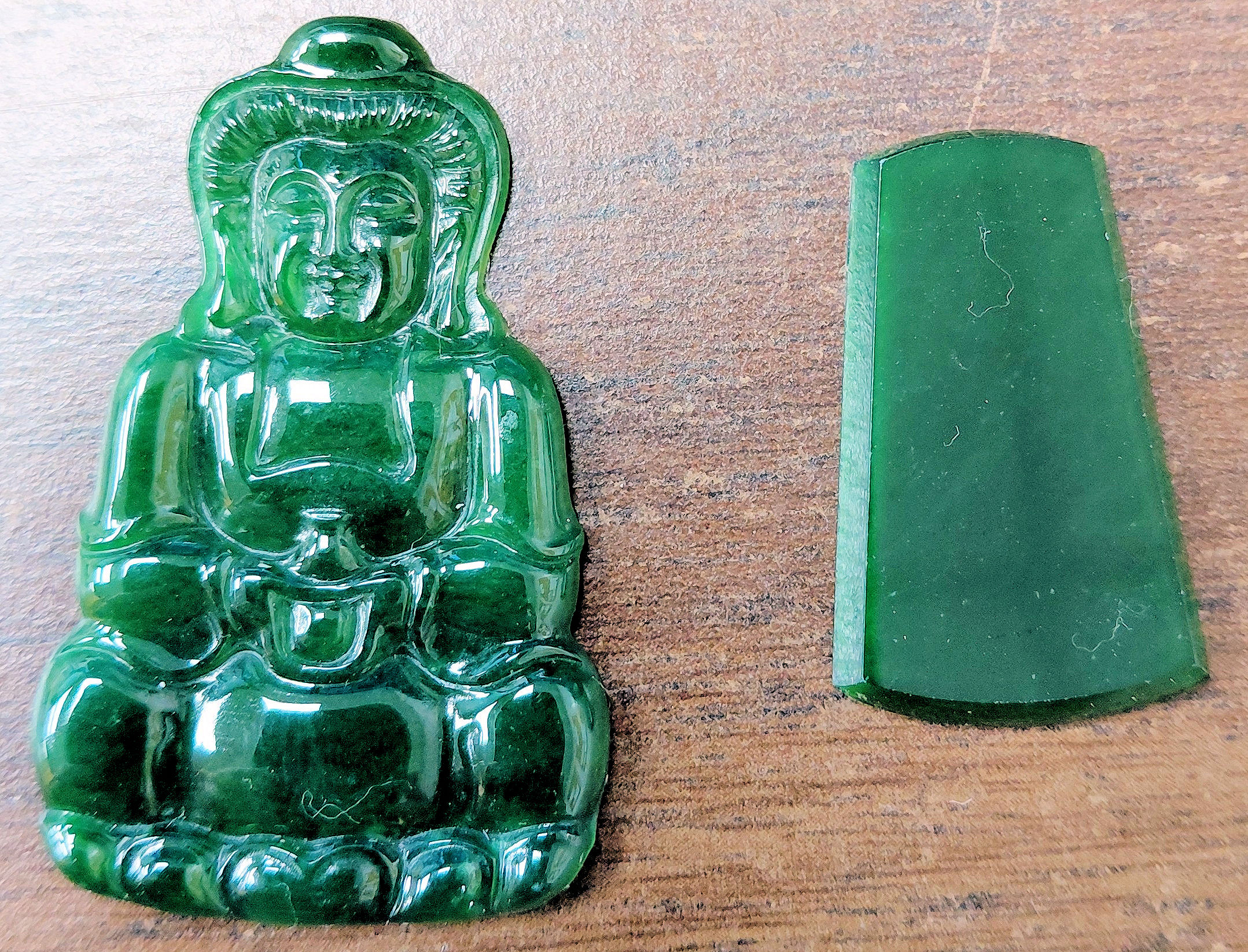
The two pieces of pendant jewelry shown above were certified by two Chinese laboratories to be Grade A jadeite, the most valued form of jade. They were purchased at a high price by the wife of a retired scientist who was suspicious that the material was not Grade A jadeite. We will call the piece on the left the Buddha sample and the one on the right the Slab sample.
The FTIR spectra of the Buddha and Slab Pendant pieces in both transmission and absorbance modes are not matches to jadeite, proving that jadeite is either not present or not the primary compound. Small peaks from ~2800 – 3000 cm-1 suggest the presence of a minor concentration of organic or organometallic compounds.
The XRF analysis of the Buddha sample shows that, of the detectable elements, SiO2 (55.64 wt.%) is the predominant oxide in the sample, followed by CaO (12.20 wt.%), Al2O3 (11.96 wt.%), Na2O (8.61 wt.%), MgO (8.57 wt.%), and Fe2O3 (2.27 wt.%), with each of the other oxides being less than 1 wt.%. Assuming that the material is pure jadeite, it would be expected to have an atomic ratio of Na:Al:Si to 1:1:2 and there would not be high concentrations of CaO, MgO, and Fe2O3, as is the case with this material. The measured Na:Al:Si ratio is 1.000:0.844:3.332, so there is much too much silicon in this material. Chromium oxide is present, which is used to enhance the green coloration. The XRF analysis implies that the material is not jadeite or jadeite is mixed with something else.
The XRF analysis of the Slab sample shows that, of the detectable elements, SiO2 (63.15 wt.%) is the predominant oxide in the sample, followed by Al2O3 (14.01 wt.%), Na2O (7.79 wt.%), CaO (7.33 wt.%), MgO (5.72 wt.%), and Fe2O3 (1.34 wt.%), with each of the other oxides being less than 1 wt.%. the elemental composition ratio of Na:Al:Si of the Slab sample does not line up with what is expected, 1.000:1.094:4.181. In addition, there are high concentrations of calcium, magnesium, and iron. Chromium oxide is present, which is used to enhance the green coloration. The XRF analysis proves that the material is not jadeite or jadeite is mixed with something else.
The XRD analysis of the Buddha sample shows that the main crystalline material by weight is determined to be diopside (93.1 wt.%), with clinoferrosilite (6.9 wt.%) as a minor contributor. No jadeite was found in this material.
The XRD analysis of the Slab sample shows that the main crystalline material by weight is determined to be omphacite (72.8 wt.%), with jadeite (27.2 wt.%) as a minor contributor.
In conclusion, neither the Buddha nor the Slab sample is jadeite Grade A. The Slab sample had a minority content of jadeite in the form of small particles, while the Buddha sample had no jadeite at all. Both the Buddha and Slab samples were claimed to be jadeite Grade A by two laboratories in China according to certification documents provided with the sale. This was clearly a case of fraud, which is not unusual for products sold by companies based in China.
The Anderson Materials Evaluation analysis report on the investigation into the Chinese laboratory certified Grade A jadeite jewelry pendants proving that neither was Grade A jadeite or even majority jade of any sort is here. This report is published with the permission of the client, whose name has been removed from the analysis report.
